

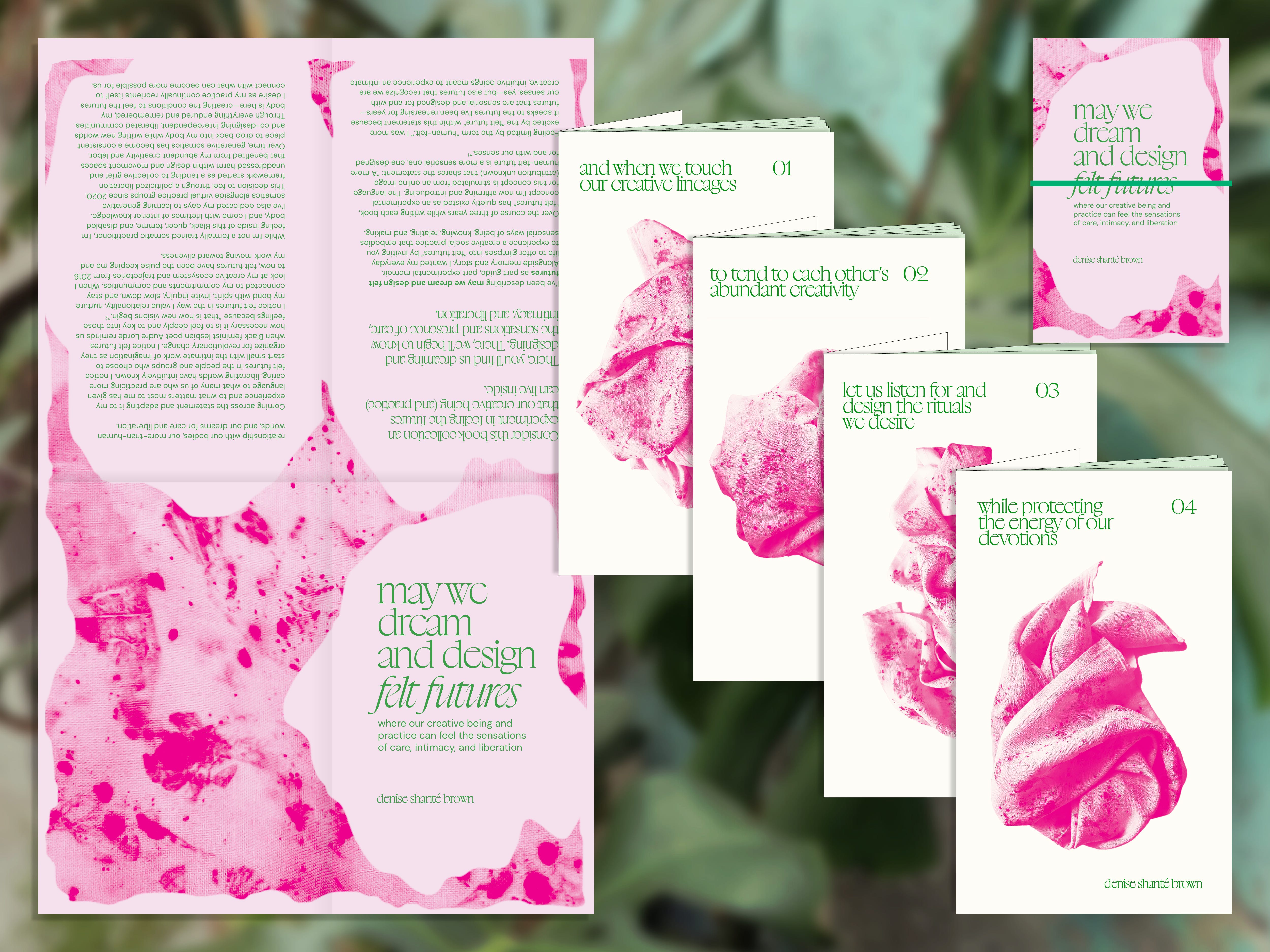
As a soft entry to this newsletter and to celebrate the announcement of pre-orders for my new book collection, “may we dream and design felt futures: where our creative being and practice can feel the sensations of care, intimacy, and liberation,” I’m sharing an early, multisensory release of the preface and introduction. This collection of four books—part guide, experimental memoir—is written and designed by me, edited and published by Thick Press, and printed by Impresos México. Shipping happens early May and you can join me for a virtual book launch and celebration on Tuesday, May 13 at 6-7:30PM EDT by registering here. I’m continually grateful for the support that made this creation possible. With so much care and love!
the preface (a read-aloud with Denise Shanté)
One of the most potent memories I have of feeling cared for and liberated in my creativity was on a golden yellow ’70s plush carpet in my Granny’s living room. This feeling started when I was maybe ten years old. I’d visit every weekend and throughout the entire summer. This was time I could depend on, because when I was with her (Levis Denise Brown), it was the only time I knew my creative being would be protected and nourished.
Without noticing the hours that would pass, I made a ritual out of surrounding myself with stacks of architecture design magazines, labeled Ziploc bags, markers, colorful construction paper, and scissors. I was joyfully dedicated to building magical spaces. I could hear tracks of Luther Vandross dancing through the air, with Granny’s voice echoing each lyric, and would later smell dinner being prepared in the kitchen: fried chicken in the cast iron skillet and buttered cabbage boiling in the pot. Nothing could disrupt this peace.
From an outside perspective, you’d probably witness a curious Black girl fascinated with the idea of designing her dream home—and that’s true. From my interior world, there was a second truth: I was deliberately reimagining myself out of the harmful realities of what everyday life at home was like and making portals to new realities through collaged magazine images of faraway casitas and tall, expansive windows that promised to let the light in.
This creative flow was my sanctuary and my journey to the sweet complexities of being, knowing, relating, and making. In those timeless hours, I was given the gift of feeling wonder and aliveness. In those timeless hours, I knew safety just long enough to touch the wild possibility of another world I desired.
Each intimate, creative moment was a dimension of myself dropping into the sensations of care and liberation through the practice of dreaming and designing. I was slowly seeding the life of a designer, someone deepening their capacity for the imaginary with an unwavering trust that a “felt future”—one sensed and known—could be nurtured into existence.
It feels necessary to remember the people in our lineages who encourage us to dream, who make the way easy for that dreaming to have a soft place to land. It also feels necessary, especially in the process of building more liberating and caring worlds, to excavate memories that remind us where our creative seeds started and how it felt.
Creativity—the embodied trust in one’s innate, authentic expression and experimentation—has been the most abundant well and resource in my life.
It brings me closer to the felt futures I long for: the kind of futures that are sensorial, intuitive, intimate, sensuous, deeply known, and fully alive.
It’s where I learn how to grieve, love, unfurl, play, release, listen. Where I call on my creative ancestors and stay receptive to what wants to be translated through my being.
It’s the body that offers tiny glimpses into the sensations of belonging. The entry point to everything and anyone who ever taught me about mutual care and intimate community.
Creativity is also alive when I’m resisting systems of exhaustion by demanding slowness and softness. It continually makes space for my capacities to move at the speed of care, demanding a future where my disabled body has what it needs to rest and recover.
I’m writing from the spirit of creativity and felt futures because I know I’m not alone in wanting to illuminate how the sensorial is shaping our worlds and continues to create the lineage, the abundant, the ritual, the dream, the desire, the protection, and the devotion.
What lives inside of us—what we know can become possible through our creative being and practice—is on the list of reasons why many of us choose to stay alive. We need it, like breath and water, to fully feel the futures we desire so that our dreams for care, intimacy, and liberation can come through.
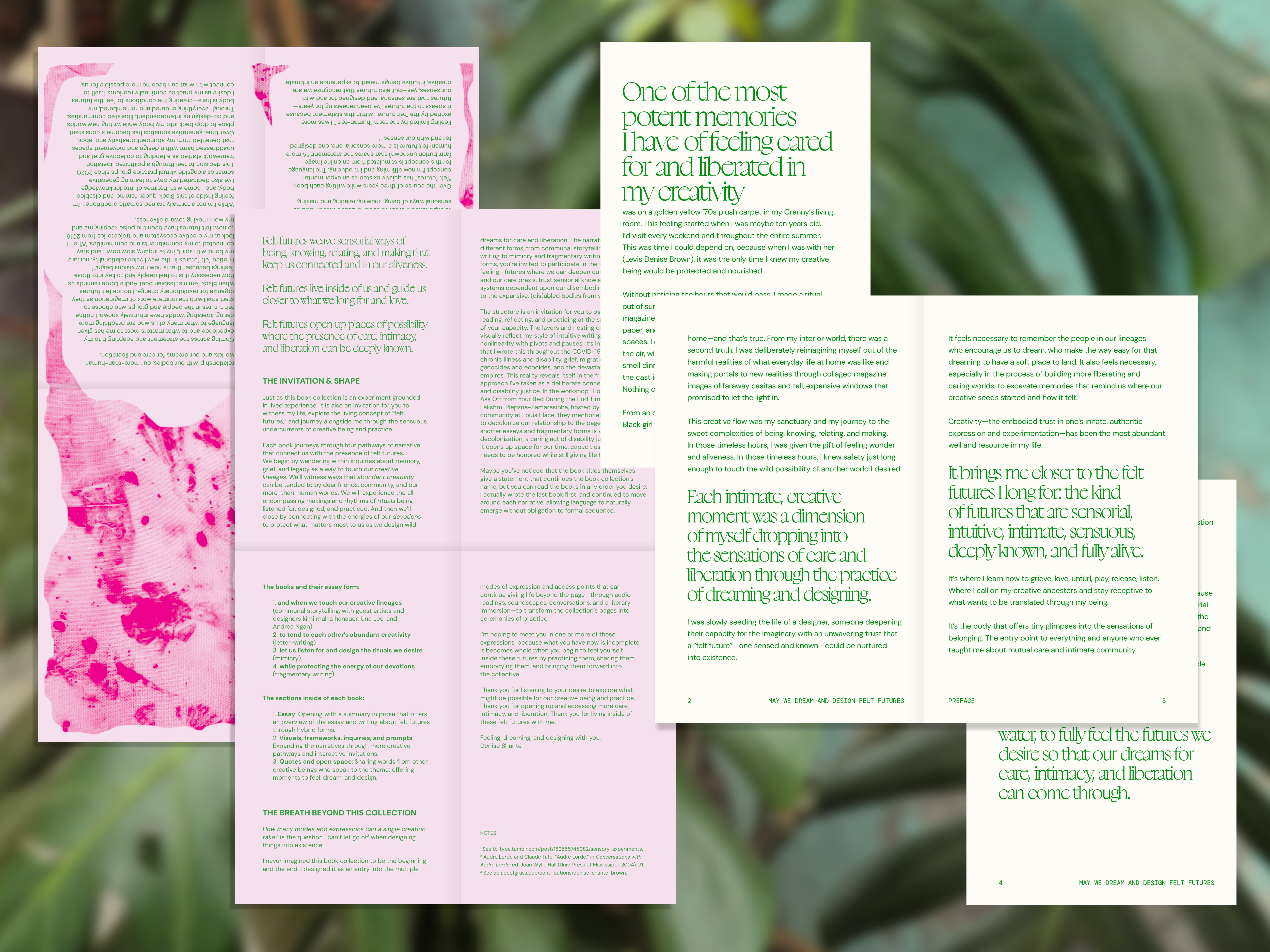
Mockups showing a poster that will be folded, containing the book collection’s introduction, along with a four-page preface.
the introduction
Consider this book collection an experiment in feeling the futures that our creative being (and practice) can live inside.
There, you’ll find us dreaming and designing. There, we’ll begin to know the sensations and presence of care, intimacy, and liberation.
I’ve been describing may we dream and design felt futures as part guide, part experimental memoir. Alongside memory and story, I wanted my everyday life to offer glimpses into “felt futures” by inviting you to experience a creative social practice that embodies sensorial ways of being, knowing, relating, and making.
Over the course of three years while writing each book, “felt futures” has quietly existed as an experimental concept I’m now affirming and introducing. The language for this concept is stimulated from an online image (attribution unknown) that shares the statement: “A more human-felt future is a more sensorial one, one designed for and with our senses.”1
Feeling limited by the term “human-felt,” I was more excited by the “felt future” within this statement because it speaks to the futures I’ve been rehearsing for years—futures that are sensorial and designed for and with our senses, yes—but also futures that recognize we are creative, intuitive beings meant to experience an intimate relationship with our bodies, our more-than-human worlds, and our dreams for care and liberation.
Coming across the statement and adapting it to my experience and to what matters most to me has given language to what many of us who are practicing more caring, liberating worlds have intuitively known. I notice felt futures in the people and groups who choose to start small with the intimate work of imagination as they organize for revolutionary change. I notice felt futures when Black feminist lesbian poet Audre Lorde reminds us how necessary it is to feel deeply and to key into those feelings because "that is how new visions begin."2 I notice felt futures in the way I value relationality, nurture my bond with spirit, invite inquiry, slow down, and stay connected to my commitments and communities. When I look at my creative ecosystem and trajectories from 2016 to now, felt futures have been the pulse keeping me and my work moving toward aliveness.
While I’m not a formally trained somatic practitioner, I’m feeling inside of this Black, queer, femme, and disabled body, and I come with lifetimes of interior knowledge. I’ve also dedicated my days to learning generative somatics alongside virtual practice groups since 2020. This decision to feel through a politicized liberation framework started as a tending to collective grief and unaddressed harm within design and movement spaces that benefited from my abundant creativity and labor. Over time, generative somatics has become a consistent place to drop back into my body while writing new worlds and co-designing interdependent, liberated communities. Through everything endured and remembered, my body is here—creating the conditions to feel the futures I desire as my practice continually reorients itself to connect with what can become more possible for us.
Felt futures weave sensorial ways of being, knowing, relating, and making that keep us connected and in our aliveness.
Felt futures live inside of us and guide us closer to what we long for and love.
Felt futures open up places of possibility where the presence of care, intimacy, and liberation can be deeply known.
The Invitation & Shape
Just as this book collection is an experiment grounded in lived experience, it is also an invitation for you to witness my life, explore the living concept of felt futures, and journey alongside me through the sensuous undercurrents of creative being and practice.
Each book journeys through four pathways of narrative that connect us with the presence of felt futures. We begin by wandering within inquiries about memory, grief, and legacy as a way to touch our creative lineages. We’ll witness ways that abundant creativity can be tended to by dear friends, community, and our more-than-human worlds. We will experience the all encompassing makings and rhythms of rituals being listened for, designed, and practiced. And then we’ll close by connecting with the energies of our devotions to protect what matters most to us as we design wild dreams for care and liberation. The narratives take different forms, from communal storytelling and letter-writing to mimicry and fragmentary writing. Within these forms, you’re invited to participate in the futures I’m feeling—futures where we can deepen our creative politic and our care praxis, trust sensorial knowledge amid systems dependent upon our disembodiment, and tend to the expansive, (dis)abled bodies from which we create.
The structure is an invitation for you to oscillate between reading, reflecting, and practicing at the speed and scale of your capacity. The layers and nesting of pages also visually reflect my style of intuitive writing, honoring nonlinearity with pivots and pauses. It’s important to know that I wrote this throughout the COVID-19 pandemic, chronic illness and disability, grief, migration, ongoing genocides and ecocides, and the devastating rise of empires. This reality reveals itself in the fragmentary approach I’ve taken as a deliberate connection to care and disability justice. In the workshop “How to Write Your Ass Off from Your Bed During the End Times” with Leah Lakshmi Piepzna-Samarasinha, hosted by the writing community at Louis Place, they mentioned how we need to decolonize our relationship to the page. Choosing the shorter essays and fragmentary forms is very much a decolonization, a caring act of disability justice, because it opens up space for our time, capacities, and access needs to be honored while still giving life to our stories.
Maybe you’ve noticed that the book titles themselves give a statement that continues the book collection’s name, but you can read the books in any order you desire. I actually wrote the last book first, and continued to move around each narrative, allowing language to naturally emerge without obligation to formal sequence.
The books and their essay form:
and when we touch our creative lineages (communal storytelling, with guest artists and designers kimi malka hanauer, Una Lee, and Andrea Ngan)
to tend to each other’s abundant creativity (letter writing)
let us listen for and design the rituals we desire (mimicry)
while protecting the energy of our devotions (fragmentary writing)
The sections inside of each book:
Essay — Opening with a summary in prose that offers an overview of the essay and writing about felt futures through hybrid forms.
Visuals, frameworks, inquiries, and prompts — Expanding the narratives through more creative pathways and interactive invitations.
Quotes and open space — Sharing words from other creative beings who speak to the theme; offering moments to feel, dream, and design.
The Breath Beyond This Book Collection
How many modes and expressions can a single creation take? is the question I can’t let go of3 when designing things into existence.
I never imagined this book collection to be the beginning and the end. I designed it as an entry into the multiple modes of expression and access points that can continue giving life beyond the page—through audio readings, soundscapes, conversations, and a literary immersion—to transform the collection’s pages into ceremonies of practice.
I’m hoping to meet you in one or more of these expressions, because what you have now is incomplete. It becomes whole when you begin to feel yourself inside these futures by practicing them, sharing them, embodying them, and bringing them forward into the collective.
Thank you for listening to your desire to explore what might be possible for our creative being and practice. Thank you for opening up and accessing more care, intimacy, and liberation. Thank you for living inside of these felt futures with me.
Feeling, dreaming, and designing with you,
Denise Shanté
See tt-type.tumblr.com/post/182555745082/sensory-experiments.
Audre Lorde and Claude Tate, “Audre Lorde," in Conversations with Audre Lorde, ed. Joan Wylie Hall (Univ. Press of Mississippi, 2004), 91.
See abladeofgrass.pub/contributions/denise-shante-brown.
this is so exciting! I resonated a lot with how you related to design/architecture books as a child. It gave me new language around my own love of design