

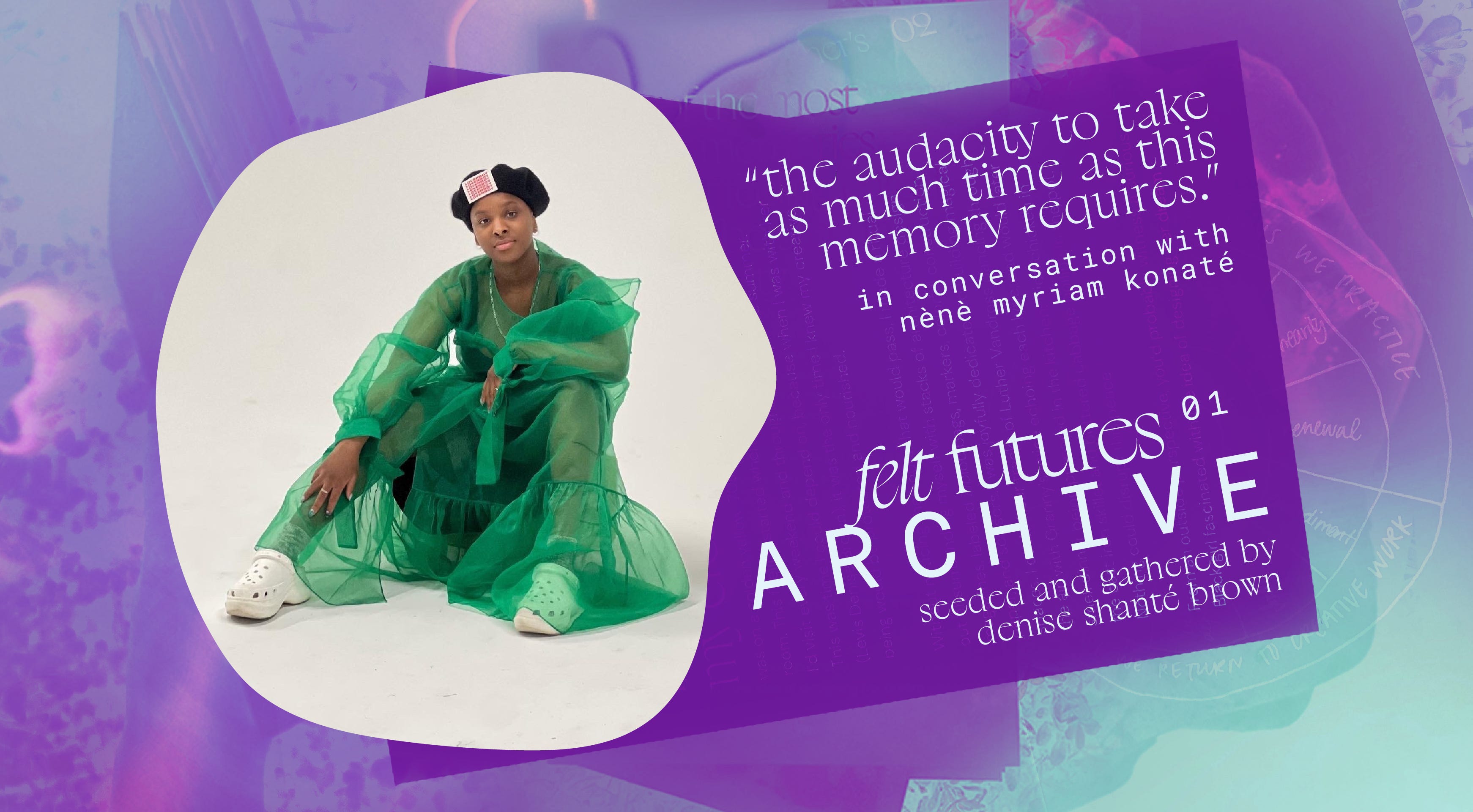
Welcome to the first expression of felt futures archive, a publication made of conversations, artifacts, and citations that memory-keep the futures we are feeling, dreaming, and designing.
Sensed into language and practice, I describe felt futures1 as “a breathing entity, creative compass, and liberatory lifeforce within us that trusts the sensorial and the sensuous as we dare to make the futures we desire a reality.” Documenting this trust, the archive exists as a record of us embracing all that we long for and love. Here, we remember what’s deeply felt as creative, intuitive beings who are seeding worlds of care, intimacy, and liberation.
On December 16, 2025 I held the introductory conversation with nènè mk (they/them) who journeyed within the inaugural cohort of experiments in felt futures, from August - November 2025. The utterances and remembered musings we shared wander through themes of fear, palpable kinship, audacity, honored curiosity, our lives as evidence, and more that reaches beyond languages.
Naturally reflecting my love for multimodality, you’re invited into an experience of reflections through audio, potent quotes, and imagery.
Who are you and who do you honor?
Denise Shanté: One of the first questions I ask folks daring to immerse themselves into experiments in felt futures is, “who are you and who do you honor?”2 I want to ask this question again because that was five months ago and your felt response may be very different now. So, who are you and who do you honor, today, in this moment?
nènè:
How is the spirit of who you are and who you honor breathing in your creative practice, right now?
Denise Shanté: As you were sharing that I’m feeling resonance and recognizing how I’ve witnessed those energies and elements present within you and also within how you choose to show up and practice. It’s such a natural transition into another inquiry: how is the spirit of who you are and who you honor breathing in your creative practice, right now?
I can sense it. I’ve witnessed it. I felt it within your presence and in the time that we’ve shared. And I would love it if in this moment we could try to bring language to things that might be a little nebulous—or beyond language—but if we can try to explore another layer related to the collapse and darkness you’re speaking of: how do you also experience collapse and darkness breathing in your creative practice?
nènè: I mean, as I was sitting with your questions yesterday, I had a moment where I felt like “Oh, everything is spilling now.” I think if I had tried to answer the questions 72 hours before, it would’ve been like “What am I talking about?” But yesterday it was like “Oh yes!” I actually thought of a passage from Alexis Pauline Gumbs’ Undrowned: Black Feminist Lessons from Marine Mammals where she says: “Before all of this, there was a deep Black dream that woke as us. And we are the ones in between enough, dream-eyed enough, exhausted enough to remember.”3 And I think that that place of exhaustion and obscurity is what I hope the threshold for my practice is. I hope that that is the point through which people enter.
I’m a few weeks away from welcoming a new cohort into The Clap Back Manifest(o), which you’re very familiar with because you journeyed with me this summer. And we were also in dialogue as I crafted the offer. My hope is truly that people can join from a place of exhaustion and, rather than feeling compelled to push past or beyond that place, to honor all of the richness that is already inside it, all of the possibilities that are already in a space of collapse, and to trust themselves enough to voice what it would mean or what it would look like to be held from that state. And so to invite human or more than human forces to witness them spilling beyond reasonable or coherent or enthusiastic dimensions. And yeah, I’m like, do these words make sense?
When I think about my practice, I think of a conversation I had with my coach, Kenta, who works with a lot of people who work in movement, somatics, creative offerings, a bunch of different things, and we were joking at some point about me. People kind of just come for the vibe. It’s maybe nebulous what the offering is, and still in an energetic sense, it’s extremely clear and it’s for the vibe, it’s for the deep belly exhale. What I hope can always be palpable in my practice.
Denise Shanté: I mean, your offering is one of those experiences that one needs to be inside of. People don’t necessarily have to have the complete language or the coherence that you shared, but is one willing to drop into what might emerge or what might be felt so they can experience it on a cellular level—or that relational level, that spiritual level—that will inevitably come through? From how I experienced it, all of this was possible because of the spaciousness and because of the breath and because of the way inquiry and curiosity were guided to come alive.
I was writing this morning and generating inquiries for another piece. And I wondered, has Toni Morrison ever written about curiosity or talked about curiosity? I did some research and read how Morrison said that her shaping of The Bluest Eye came from a lot of questions, memories, and painful experiences she had witnessed or been privy to; that her first impulse to write was about curiosity.4 Remembering my own curiosity with that book when finding it tucked away on the library shelf in elementary school, it’s making me think about what’s necessary for inquiry to even feel possible; for us to have the breathing room to be with the questions and to explore them in our practice?
You also bring up Alexis Pauline Gumbs when speaking about darkness and in the essay, learning to listen, (that I read again and again and again within the Healing Justice Lineages Project and Anthology) she weaves many questions throughout. She then closes the essay with a statement that says: This download came after a conversation with Dr. Barbara Holmes who asked me, “What does it mean to listen darkly?”5
nènè: Yeah. Oh, I mean, I haven’t read it, so now I’m like, I want to and I have to, and I’m so curious about this notion of listening and or dreaming darkly.
Yeah, because I guess I’m also just fascinated by fear. I am really fascinated by all the monsters and the creepy crawly things that are in our dreams and what they have to say to us if we dare to listen and what’s happening in all of these places within and beyond ourselves that sometimes we’re afraid to journey towards.
And yeah, I think maybe a lot of those questions come from my disabilities, maybe about existing daily on the other side of what sometimes is considered to be possible. And so having to traverse fear anyway because it’s just what’s required. And yeah, I’m just curious, what are the pathways that we’re carving on a daily basis when that’s what we have to do?
— nènè myriam konaté
We constantly have to move through fear and we constantly have to improvise what kind of rituals are being formed in that time. And then that makes me think of your offering, of course, and how ritual design and devotions were so embedded in experiments in felt futures and how we could hold it at any scale that felt possible for us. Like a ritual could be something extremely mundane. And then, in having the chance to sit within the cohort in dialogue with everyone, and in just fully immersing ourselves in our rituals, we could see all of the ripples that come from these mundane gestures. And then there were bigger ones. But yeah, I don’t know. I’m just thinking so much about repetition and improvisation and fear and limitation, and these are all things that are always swirling around my spirit.
Why did you feel compelled to offer your full-bodied Yes and journey within experiments in felt futures?
Denise Shanté: In the swirling around and truths about constantly moving through fear, I wonder why, then, do we choose to enter experiences that can open up more feelings? Why did you feel compelled to offer what I’m calling “your full-bodied Yes” and choose to journey within experiments in felt futures alongside the fear?
nènè: I feel like I decided that it was a Yes for me long before it went up on your website. It was when we were in Seeda School together and you were talking about it, and I think that maybe initially you spoke about the book collection and how each book would be, in one way or another, accompanied by some version of an affective journey. And I was like: “Oh, okay. Yes.” And then you talked about crafting an offering around it, and even in the illustration that people can see on your website, we can see all of these kind of circular and almost fractal motions that create the four months. Something about the offering felt so clear and so infused with care at every level.
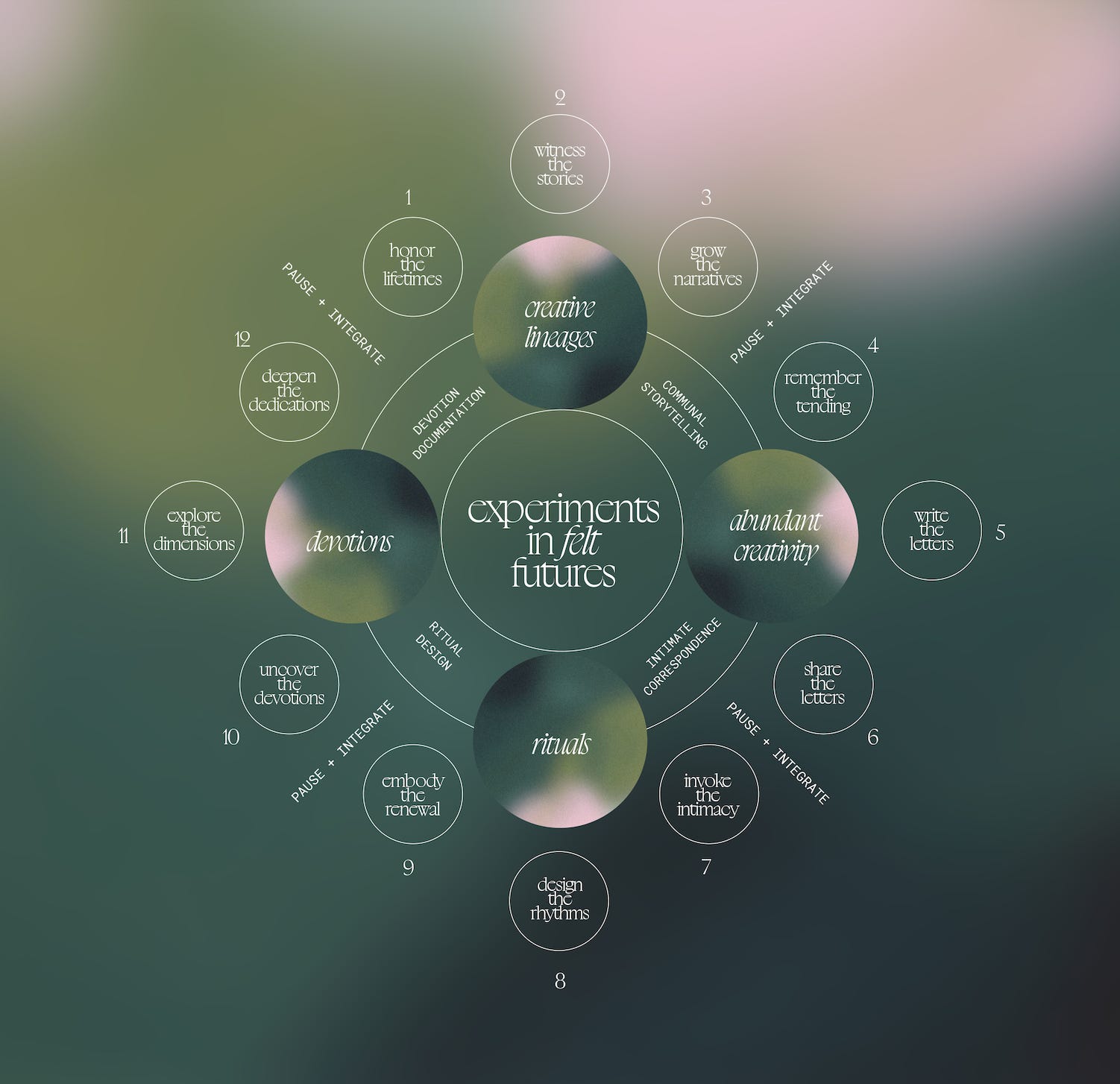
And it also felt like a testament to your creativity while inviting the creativity of anyone who would take part. I think that I said it before I signed up and I said it while I was in the experience, and I said it after, I was like: “This is my dream school.“ So for me, it’s an obvious and emphatic full-bodied Yes. Because I had the chance to learn with and from everybody who was present, to learn with and from you, and also to be in communion with different parts of myself that your facilitation brought out.
— nènè myriam konaté
nènè: And when I entered the experience, I didn’t necessarily know exactly what it was going to look like or exactly what it was going to feel like. Still, because of how the space was held and facilitated by you and also the energies that everybody else brought into the journey, I felt like different parts of me could come through, and that was really, really special. There are questions later that will speak to this, and I will say more.
Denise Shanté: You didn’t know what to expect or how you would feel once being inside the experience and I’m like, me either! I had no idea how many people would resonate with this kind of experimentation or what could be fully possible alongside everyone who ended up feeling compelled to extend their full-bodied Yes as well. It’s one of those situations where trusting my dreams that shaped this offering was its own felt future.
nènè: Absolutely.
What’s one of your most potent moments and memories? Why is it still lingering with you and within you?
Denise Shanté: In this journey and commitment (because it was very much a commitment with meeting for four months, twice a week) we connected with the presence of felt futures by sensing our creative lineages, abundant creativity, rituals, and devotions. We did this through the practices of communal storytelling, intimate correspondence, ritual design, and devotion documentation.
I’d love to know within those four months—with the sensing and practices that we moved within—what’s one of your most potent memories and moments and why do you feel like it’s something that’s still lingering with you and within you?
nènè: I think that my most potent memory from the journey is kind of like a few moments folded into one. I think that it begins in one of the breakout rooms. I think when we were rooting ourselves in Abundant Creativity, we were doing letter writing, and I was in a breakout room with Ariel. And Ariel was sharing on ancestry, memory, music, language, and I was so moved by everything that she was sharing. And it’s like I can remember how it felt to listen to all that she was saying, and I’m not remembering necessarily all of the words. And she shared what inquiry was guiding her that specific week and potentially throughout the entire journey, and asked me what inquiry was carrying me through.
And it was only through her prompting and in being inspired by all of her shares that I realized that the question that was carrying me through the whole journey or that would, because we were still towards the beginning, was “What does my childhood look like in the present?”
— nènè myriam konaté
And then that, I think, is really something that rooted me, particularly in the letter writing. And when you invited us to craft a space, like a soft space to write from. And I reached into my little memory/treasure chest, and I got this postcard from my beloved bestie Caro that she sent me from Paris when we were 10 or 11 years old. And something about the spirit in that postcard and the spirit of that kinship felt palpable throughout the journey. And it’s still so present for me how just the shape of the journey really did allow me to reach through time and to feel what used to be the future that Caro invited me into. And that, because of her love and care, is now the present. And so I really did feel myself moving through time sensing futures that were present 20 years ago, and in that way also feeling futures that are present now. And I think that, yeah, that’s the memory. I mean, it’s one of various memories that continue to echo for me, for sure.
Denise Shanté: I love hearing how you already have this relationship to memory, tangibly, and also what I’m hearing as ancestral memory. It’s even more potent with what I know of your personal connection to Toni Morrison’s writings on (re)remory. There are moments when we may not explicitly name who we’re bringing along with us throughout the journey yet they end up showing up anyway because their feltness—and our memories of them—are indelible. The people and spirits who need to be with us end up making themselves known or asking to be invited into the experience that deep parts of ourselves are about to move within. It’s a question to really rest within:
Who are the people, ancestors, or more-than-human beings and forces who’ve joined us at some part of the journey? And how have our fellow experimenters helped us call them in, feel them in?
There’s a lifeforce within the relationships being formed in the cohort through the stories and memories shared, especially when everyone has collectively chosen to feel, to remember, and to try some things on. We are all, in some shape or form, embodying. . .I don’t think it’s courage. I think it’s audacity. The audacity to remember, to return, to be carried by those memories and to be held by them, too.
nènè: And I think, also, the audacity to take as much time as this memory requires, I think that that was one of my favorite things about the journey. That, yeah, it’s four months because that’s the time that it takes. And if we tried to condense the experience, it would be entirely different because it takes time.
It takes time to fall through different layers and textures of feltness. It takes time to really breathe through different memories. It takes time to create and deepen trust with people. It takes time to let inquiries emerge so that the inquiries can kind of be nesting dolls.
— nènè myriam konaté
There’s always more inside of each, and we need time for that. And that felt like one of the generous gifts of experiments in felt futures. That we actually had time and that was so special because I think that the spirits that accompany us, sometimes they’re there for the whole journey, sometimes they’re there for a portion. And because you invited us to notice at the beginning of each gathering, then we could actually really tap into the energetic frequency of each moment and notice like: “Oh my gosh, during Creative Lineages, I really felt this energy present. And now, during Devotions, I feel this different energy present, and I could feel it like this in week three. And it actually was a bit different in week one.”
And the only way to know that is with time and with the stillness of noticing. And so I really appreciate the pacing of it all, and even the pause and integration weeks, I felt like those were times where I could potentially feel even more of what was present because I was just digesting everything that already happened in our shared space.
Show and storytell about an artifact that represents something you felt, dreamed, or designed during our journey together.
Denise Shanté: Wow. It is almost hard to believe that it’s done because you, as a fellow space holder, facilitator (whatever framing or language you want to use for that), know that it’s never just the container or creative offering itself that we are feeling and experiencing. It’s everything that has transpired before, during, and after. A four-month literary immersion is really eight months, or more. I can still feel this kind of rippling sensation and that’s the sweetness of being able to have these kinds of conversations, too. We’re inside a special moment and opportunity to stay with experiments in felt futures a while longer, as we archive and memory-keep through shared reflections.
I wanted to invite you to show and storytell about an artifact that represents something that you felt, dreamed, or designed during our journey together. The creative act of archiving and memory-keeping can come in so many forms, so I also wanted to keep this open as far as the mode that people choose to share—whether it’s something written, voice recorded, visual, or otherwise. I’d love to witness what was chosen for you.
nènè: I’m going to get it. Really, I feel like yes, there are things I wrote, et cetera, et cetera, during this journey and the thing that felt most special really was this postcard from Caro. Because I don’t think I would’ve held and touched this card had it not been for the conversations that we had within our gatherings. I always remember it. I always, always remember it. And at the same time, I really felt like a pathway was carved throughout the gatherings to bring me back to the physical presence of this card, to let my imagination travel to my 10 or 11-year-old bestie being in Paris with her family and telling her Mom: “Oh, we have to get a postcard for nènè!” And taking the time, the time to write it and to share this moment with me from a place I had never been to, Paris. I thought it was so fancy that she went there because she had relatives over there.
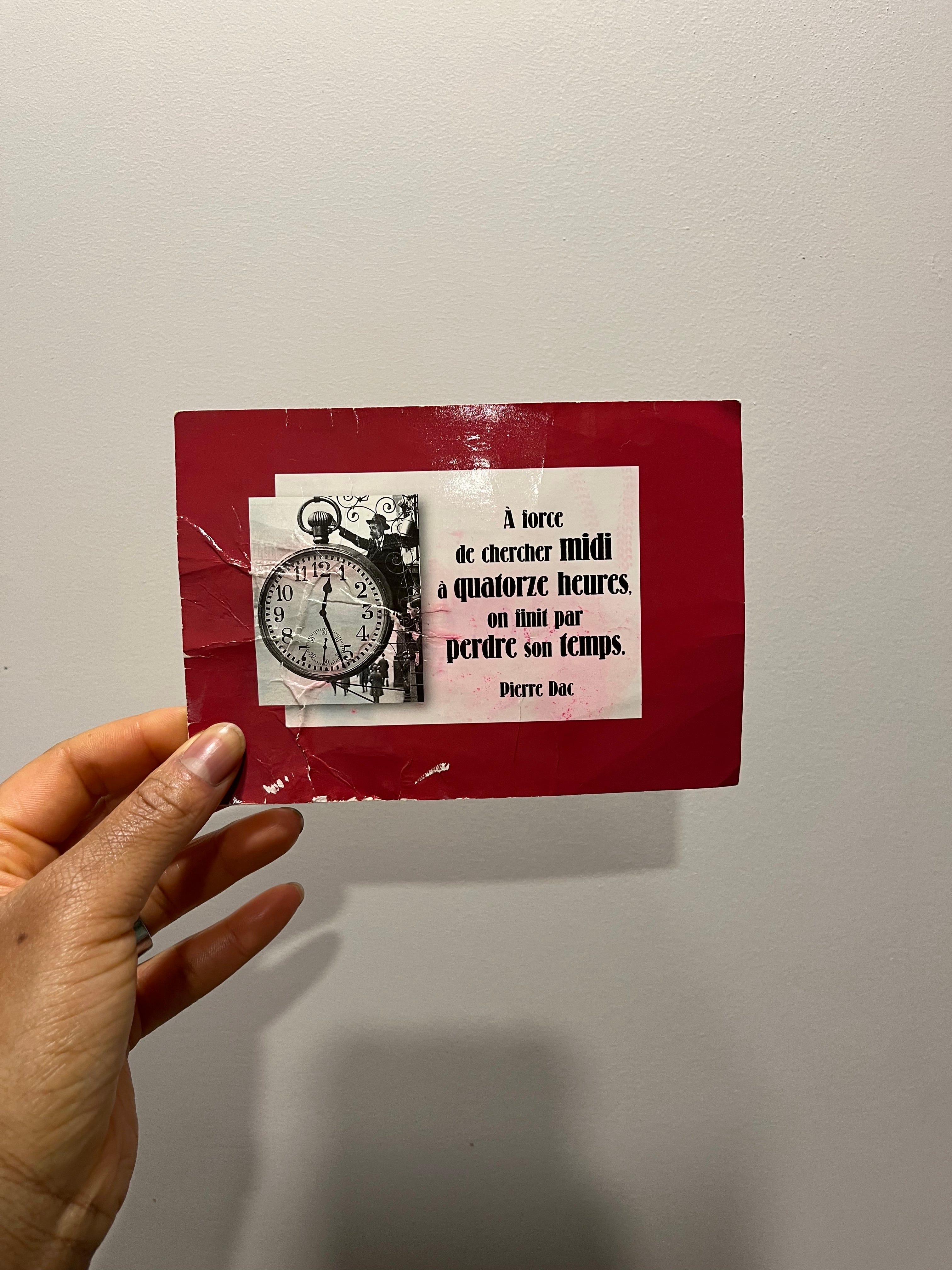
And to sense that everything that she said 20 years ago is still true today, so this is as much from the past as it is from the present and the future. And I think that it really just grounded me in all of my reflections and my emotions throughout the journey. And it’s like because I have a friend like Caro, I can also have a friend like you. So much of this kinship is at the heart of who I am, who I was, who I became, it’s really through the love of this person. And so this felt like the most important thing to commit to the archive.
Denise Shanté: I’m truly honored and touched by your expression of how there are connections in our lives that allow other connections and kinships to exist. The tangible artifacts we have that are holding the breaths of these people who make more love possible—I find myself so protective of them and want to keep them sacred and close. I have letters from my father, Granny, and Aunt Flossy. I call them the trio of ancestors who loved me the most and taught me what it means to love and be loved. I guess I’m curious about what happens if, or when, we lose these tangible things. What remains beyond the tangible artifact itself that we can still touch and hold? How do we stay with the senses of this particular kinship and connection? Do you feel like the memories and everything that moves through your body when holding the postcard from Caro has become a part of you?
It's kind of like the definition of what it means to embody a practice by Tracy Stanley: “A sense of carrying the wisdom of the practice in your cells—you are in such a deep relationship with the practice that it becomes a part of you.”6 I feel that the essence of these artifacts, energetically tied to loved ones, help us remember and they become a part of who we are; they become embedded into our being and what we practice. If this artifact disappears, if it’s lost, if it no longer exists, what of it do you feel you would be able to remember and continue carrying along with you?
nènè: I think that I could still, on a visceral level, remember the sensation of it beyond the sensation in my hands or the texture of the paper (that, apparently when I look at it, I spilled some water on at some point, or who knows what happened).
What I always remembered is how it felt to read the words. And that is inscribed in me somatically because, even when we were having the conversations within experiments in felt futures that prompted me to remember this postcard, I could remember it because I remembered exactly how it felt to read it. I had forgotten all of the words, and I remembered exactly exactly exactly how it felt to read it. I remembered what it looked like. And so when I went to look for it in this box where I have almost every card anyone ever gave me, I knew exactly what I was looking for.
— nènè myriam konaté
And it probably took me all of five minutes to find it because I remembered it. And so I think that yes, if this physical object disappeared, it would still very much be a part of me and the memory would be alive. And I’m thinking of how letters in particular have that power, because I’m thinking of different letters that I stumbled upon when I was a child. I found these letters, or maybe my mom actually showed them to me, that my mother had written to her father when she was a teenager or maybe in her early twenties. And I remember how it felt to read all of them. I remember that it felt kind of like being reintroduced to my mother. And, at the same time, it was like everything that was in those letters before I read them, I knew to be true. And it was a more palpable level of truth.
And at some point, I had found a letter from my youngest aunt to my mother, and it felt the same way. It felt like something that I had never had language for, and that felt present within my aunt’s energy now was written and it was in her teenage penmanship that I had never seen before. And so I may never touch those letters again. And at the same time, I remember them and I know where they live inside of me, specifically. And now I also have a better sense of their affective coordinates within my lineage. And yeah, that’s the magic of it. I don’t know, you can read something one time and literally it changes you on a cellular level, as you said.
Denise Shanté: I mean, particularly with the act of intimate correspondence and letter writing, and especially when those letters contain memories and worlds of their own. As you’re describing reading letters written and shared between other people in your family beyond yourself, you’re getting glimpses (and eavesdropping in a way) into their interior worlds; these truths, relationships, and lineages you may have never known at that depth unless the intimate correspondence existed. And that’s what letter writing does and that’s why we were practicing with it.
nènè: Exactly. Exactly. It really felt like the whole journey was perfectly designed to help us feel. And while yes, each month had its own structure, it very much felt like each month spilled into the next. And so there was the possibility to amplify the feltness.
I think back on the journey sometimes, and I’m like, I really need to sit down and work on my facilitation game because Denise Shanté really be designing things so perfectly. I’m like, yeah, you can think about how you design something a little bit more.
Denise Shanté: Let me tell you—I was thinking back on when I had to do presentations in college, I was horrible at it! These moments of guiding experiments in felt futures and this entire year of returning to space holding on my own (outside of networks and grant agendas) I mean really having the opportunity to return to my own facilitation style has been taking me back to memories of early presentation and facilitation days. I think holding space gets emphasized when we are in those educational, academic environments. The “show and tell” or holding a class’s attention when presenting a project. In my undergrad years, I remember just feeling awful after a presentation. I was like, I can feel none of that resonated or connected with anyone at all. And—I also wasn’t giving the art of facilitation and presenting the attention it requires.
It truly is an art that we evolve—the conversation of it, the storytelling of it. I have so much gratitude for one: being guided and supported by specific people in my life who taught me the art of facilitation, sharing our practices, and what it means to invite people into a particular space, a particular world. And two: I think so much of it comes from us allowing ourselves to not always be facilitators but to be present participants within spaces and experiences, too. For me, it feels impossible—and also disingenuous—to try and hold space if you don’t also know what it feels like to be held in space.
So anyway, thank you. Thank you for your warm compliment and for your noticing because when I start tracing the past lineages of my facilitation and presentation history, that shit looks wild!
nènè: Well, you’re here now! I promise if you hadn’t told me, I would have had no way of knowing because it did feel like you entered each gathering with the intention to hold and be held. And I can’t speak for everybody else who was present, but that encouraged me to show up with honesty. And so it’s like, yes, there’s the free flow of dialogue and still there’s the design structure that is holding us, and that is making sure that each week we are where we need to be. And so it just felt really cool.
It felt like an opportunity to exist in your design mind and design heart. And so I found it to be really lovely to see how the structure that you created, and were creating throughout, allowed for a certain level of care for yourself and for others. Because that’s something that I’m always curious about in facilitating. How can I invite people into something that keeps me whole and that keeps them whole as well? And sometimes it’s like: “Oh yeah, this is so improvisational and it went fine. And also next time there can be more planning.”
— nènè myriam konaté
I think there’s a sweetness. Yeah. Like you were saying, this combination of both. This interweaving with that fluidity that meets structure. Yeah, it felt like a very sweet harmony. Yeah. It felt like it was just enough of everything. Yeah. Yeah.
How would you describe the futures you are now designing into existence? Who’s there alongside you?
Denise Shanté: I’m receiving that. I’m also hearing what you described earlier as the “spillage” that happened. As we spilled week to week, and after your experience of being held in our space, how would you describe the futures you are now designing into existence and who’s there alongside you?
nènè: I’m like, what did I write in my notes about this? I’m like, what am I doing? Yes. I think that the futures I’m designing right now are super connected to the journey within experiments and felt futures. Because if I think back on the first month of Creative Lineages in one of our broader group conversations, I remember thinking about how I’ve always been invited into dialogue-based lineages. Sometimes certain generational doors are closed and those were somehow always opened for me in the sense that I remember sharing that I was a kid who sat at the adults’ table and who listened and talked to the adults. I had zero awareness that you’re supposed to shut up. My parents would just let me run my mouth. And so I would be sitting at these events, these family gatherings, where it’s mostly Haitian people and a few West African people, and they’re talking about all the problems of the world, and they’re talking about politics, et cetera, et cetera. And I would just be a kid and be like: “well, actually, I think about…”
And I think that that’s one of the greatest gifts that my parents ever offered me: the gift, in many ways, in some facets of life, of honoring my curiosity and welcoming it as legitimate and welcoming my inquiries as legitimate and really pouring into my imagination and into my desire for some version of analysis. I think that that’s the one thing that my parents always, always supported. And so while my knowledge is very limited, my curiosity is vast. And I think that the futures that I’m reaching for are futures that allow me to continue to be curious and that carry that child into the future. And I always love moments where I kind of feel like I’m sitting at the adults table.
— nènè myriam konaté
Right now, I’m immersed in kay, darling’s offering, which they co-created with their sister, Erica Joy and various other collaborators called Anarkata Rising: a Black Fugitive Series. And I love that I can enter some of these conversations and know absolutely nothing. And every time that somebody opens their mouth, I learn something, it transports me to a different place, and I get to feel like that kid again. And also because of the way that the space is held, I know that there’s the possibility of voicing a question. I know that there’s the possibility of sharing something that I feel might resonate.
And I think that the question that is really animating any futures that I’m designing at the moment is the same question that I carried into Seeda School when we were in that cohort together. It’s: “What is always already happening?” And I feel like this question has actually been reactivated for me through our friendship and our creative co-conspiration because of how multimodal and iterative your practice is, and in just our natural shares, how you will show me how something is already present for you in something that you’re doing, or maybe you’ll even bring my attention to how something is already present for me.
And I feel like our friendship has really been a nurturing space for that question so that it could return to me with more volume. And so I think that the people who are there with me in these futures, it’s you for sure. It’s Kay and Erica Joy who crafted this amazing offering. It’s Caro who is always there. It’s all the people who have loved me into the future, all the people who have confused me too, and that I’m like: “What is that? What?” Like people who have confused me in a good way. Sometimes people have confused me in a bad way. And so I think that all of that is present, and I think that anything that makes me feel like, I don’t know, stupid and silly, that’s where I want to be.
Denise Shanté: That’s something that I always admire about people who are more free in the space of “feeling stupid and silly.” I can definitely feel my insecurities in that regard.
nènè: I mean, same. I feel insecure until somebody’s like: “No, no, no, it’s okay!” I definitely attended some Anarkata Rising gatherings, and I was like: “Oh, but I’ve been out of school for a really long time and I’m not in the same organizing circles as people who are here and I don’t know anything.” And then people keep talking and I keep listening, and it’s actually okay that I know nothing. And then I get to just be like: “Oh, this was really sweet. I can arrive with zero knowledge and that can be okay.”
I think it comes with spaces, for me, where I know I won’t be overpoliced around what I don’t know or what is proper language and terminology for this, or comparisons aren’t being made on how long you’ve organized or how long you’ve been committed to this particular mode of practice. And so yeah, it’s like spaces where there can be grace and that way of being that can allow us to expand and to soften and to open up in a way that allows for the unknown and the learning to happen.
Denise Shanté: Yeah, absolutely. I think it has everything to do with the way space is being designed and held, moment to moment.
nènè: Because as much as I’m saying this, because I’ve been in some lovely spaces, I’ve also been in some spaces where I’m like: “I don’t feel so good about me not knowing things right now.” Because I think that it’s just so felt, it’s so palpable when a space is actually about learning. Because if a space is actually about learning, then it’s absolutely okay for us to arrive not knowing things. It’s absolutely okay for us to make mistakes, but any space that suggests that an expertise is required to enter becomes so stressful. And when I say expertise, I don’t mean the inherent expertise of our lived and embodied realities, which we all carry, but yeah, expertise in some form of certification, even if that certification is a co-sign from everybody who’s seen you organize with a specific group of people or things like that. Yeah, I think that there’s such a deep exhale that’s possible in spaces where it’s explicitly stated and it’s genuinely practiced that we’re all here to learn and to try stuff out together. And I feel like it makes everybody there soften and then that allows me to soften as well.
What questions are you asking and wandering within?
Denise Shanté: Our bodyminds need the grace, the softening, and the exhales in the spaces we hope to be held within. We’ve also talked a lot about the necessity of inquiries and questions, and that mode of being is something that the two of us share. I noticed it after we started getting to know each other more. I was like, “oh, nènè also loves questions!” I love creating inquiries and wandering within them, seeing what comes out on the other side of curiosity and aliveness and imagination that we can explore together. You’ve shared a few questions and now I’m even more curious, are there other questions you’re asking and wondering within?
nènè: Well, I think that there’s a question that I shared earlier that I think is very present for me. I think I shared some version of it and it’s: “What am I afraid of?” and “What does this fear know about me?”
I’m curious, and I guess this is just for me. I’m curious about all of the moments where fear shows up when I’m about to know something deeper about myself and fear is that vessel towards knowledge. What are all the behaviors that I build around that fear in an attempt to avoid it or bypass it? And then what does it look like when I just exist in it? What can I know from that place?
I think, honestly, releasing my nine week offering in the summer was part of that. I was definitely super afraid to do it. And then I realized that my fear remembered all of the different people, places, and structures that led me to believe that it was impossible for me to root myself in an offering that honors my needs, my capacity, my exhaustion, and that something in my fear knew that, while all of those things had happened in the past, I had also articulated various versions of my offering.
— nènè myriam konaté
And so I don’t even know if the words I’m saying are making sense right now, but the presence of energies that are attempting to, what’s the word? Like attempting to move you away from yourself, I think can bring about fear. And, at the same time, you’re already here inside yourself. And so as much as they try, it’s all good. And so I think that that’s a fear that I’m still moving through now in offering another cohort and then in sitting and really just listening to what the experience has been for everyone who has moved through this container with me, and trusting that we can make more of that and that everyone who is drawn to this practice is coming with different facets of the magic required to make it happen.
Denise Shanté: A thousand percent resonance with what you’re sharing, especially around fear, the noise that can be so loud. It can not only come from within ourselves but actual exterior voices and experiences that our bodies remember.
We really need intentional moments of making time to say, “All right, I know I’m feeling this and I’m choosing to be with this fear. I acknowledge it and I’m going to move through it. And, I also want to take some time to look at the archive of evidence that tells me—and shows me—how I’m completely capable and the person meant to be doing this. My life is an archive of all of the things that echo what’s really true.” I literally write down those moments, I revisit those memories when I knew it to be absolutely true. This practice of returning to evidence of truths I need to remember has held me in so many ways, especially those really big moments of needing to launch something new, publish a book, or be on a big stage and speak in front of people and audiences that I once dreamed about.
Those moments are scary as fuck! It can get so loud and so cloudy in our bodyminds. I know there’s that luminous part of myself who will shrink and try to hide if I don’t go back to the evidence of who I truly am and don’t go back to the memories of those who love me the most; who remind me of the capacity and the depth and the creative possibility that continues to live and breathe within me. It’s in the letters. It’s in our friendships, our kin and folk.
nènè: And I feel like the evidence that you speak of, those are all felt futures as well. Every time that you reconnect with that evidence, it could just be how you felt when you were doing something that you knew that you needed to do. It could be words somebody shared with you, letters as you said, it’s like, yeah, there’s a fear. I feel like it’s like jumping into some version of a parallel universe and, while there’s this weird palpable certainty that you’re supposed to do it, everything else that surrounds it feels slightly uncertain. That in and of itself is scary. But yeah, I do feel like that evidence, it reaches across and beyond time and it lets you know like, oh, this is already over there in the future.
Complete this statement: felt futures are. . .
Denise Shanté: Yeah, we’ve been here before, we’ve done this. We’re now here, just doing it in a different way, with a different version of ourselves. This brings us to some sweet closing questions that I feel are naturally entering our conversation at this particular moment. I have this sort of prompt invitation for you to complete this statement: “felt futures are . . .”
nènè:
Felt futures are always already present.
((( quiet space, feeling into whether something more wants to come through )))
Denise Shanté: That can also be it.
nènè: Yeah. I was like, I think that’s it. I was like, is there more coming through? It came through already.
Denise Shanté: I changed the framing of this prompt a couple of times. I was like, “I want to keep this open and expansive” because my intention is not for anyone to “define” felt futures. We don’t need to do that here. It’s more about how felt futures are living and breathing for you because they can be an embodiment of so many things, in so many expressions.
nènè: Yes, yes. Speak to it. They’re always already present.
What do you want people who are considering joining experiments in felt futures to remember?
Denise Shanté: Yeah, I like that. And I believe that to be true, too. This next question is connected to a similar question you asked during our conversation for “manifest(o) musings.” What do you want people who are considering joining experiments in felt futures to remember?7
“I want people to remember that this literary immersion is a soft landing for your full self and all of the futures that your self and/or your selves are infused with. I wrote down details as to how this happens: “This space is crafted with so much clarity and care that each gathering feels like a homegoing.” And I believe this to be true, and that’s what I want people to remember.” — nènè myriam konaté
Denise Shanté: Thank you, nènè.
nènè: Thank you for inviting me in to experience it.
Denise Shanté: I feel full of wonder and gratitude and also this ongoing curiosity because the nature of experimentation is grounding the experience so we can have an ongoing rehearsal with ourselves, and to do that within an intimate community that forms. As a space holder, it keeps me in a space of wonder, too. There are things that I’ve been writing about felt futures that came through because of us being within the four-month literary immersion together; language that’s not even in the books. You know what I mean? There are worlds of understanding being built beyond the book collection, which was the hope. It’s like, what if we keep extending the felt sense and understanding of what felt futures is and can be for us?
I always ask the question of how one creation, or some single mode of expression that we’ve poured out into the world, can start to grow beyond what we may have initially imagined it to be? So yeah, I feel very much in the growing and the emergence of this experience with you all, too.
nènè: Yes. I’m so excited for you and everyone who will get to experience it with you this winter. Yeah. I just trust that it’s going to open up even more portals into different timelines, and it could only ever be powerful.
Denise Shanté: I’m curious about the season changes too because the four months with our cohort, this initial one, was fall/winter and the second will be winter/spring. It contains two seasons in one experience. What’s going to shift or be different?
nènè: And I feel like there’s also a thawing out that happens as winter becomes spring and people start to unfurl a little bit. And so that’ll be so interesting to see. What does that look like?
Beginning with “may we . . .” cast a spell for yourself and for all creative, intuitive beings who choose to begin by feeling.
Denise Shanté: At the end of each literary immersion. We practiced casting spells. This started with my love, love, love, love for the book, Dear Senthuran: A Black Spirit Memoir by Akwaeke Emezi. Akwaeke talks about spells8 and how they’re the way we make the future we desire more real. After four months, we now have so many collective spells that were cast by the cohort. I want to continue this practice in our conversation as well and invite you to cast another spell for yourself and for all creative, intuitive beings who choose to begin by feeling9.
nènè:
Denise Shanté: Thank you so much, nènè.
nènè: Thank you. It felt so nourishing to just be in conversation today and to reflect back on this journey. Yeah, reflecting back, but I’m like, even though we still don’t have the weekly gatherings anymore, it’s not done.
Denise Shanté:
No, It’s not.
nènè: And particularly because I’ve been attending Kay’s offering, and so I’m like, yeah, this is just a breakout room of experiments in felt futures.
Denise Shanté: So many beautiful extensions. And I hope that the Felt Futures Archive can also be that for us as well. It’s like this place for us to return and remember and just continue carrying this moment to the next. In the ways that we want to.
nènè: Yes. Yay!
about nènè myriam konaté (they/them)
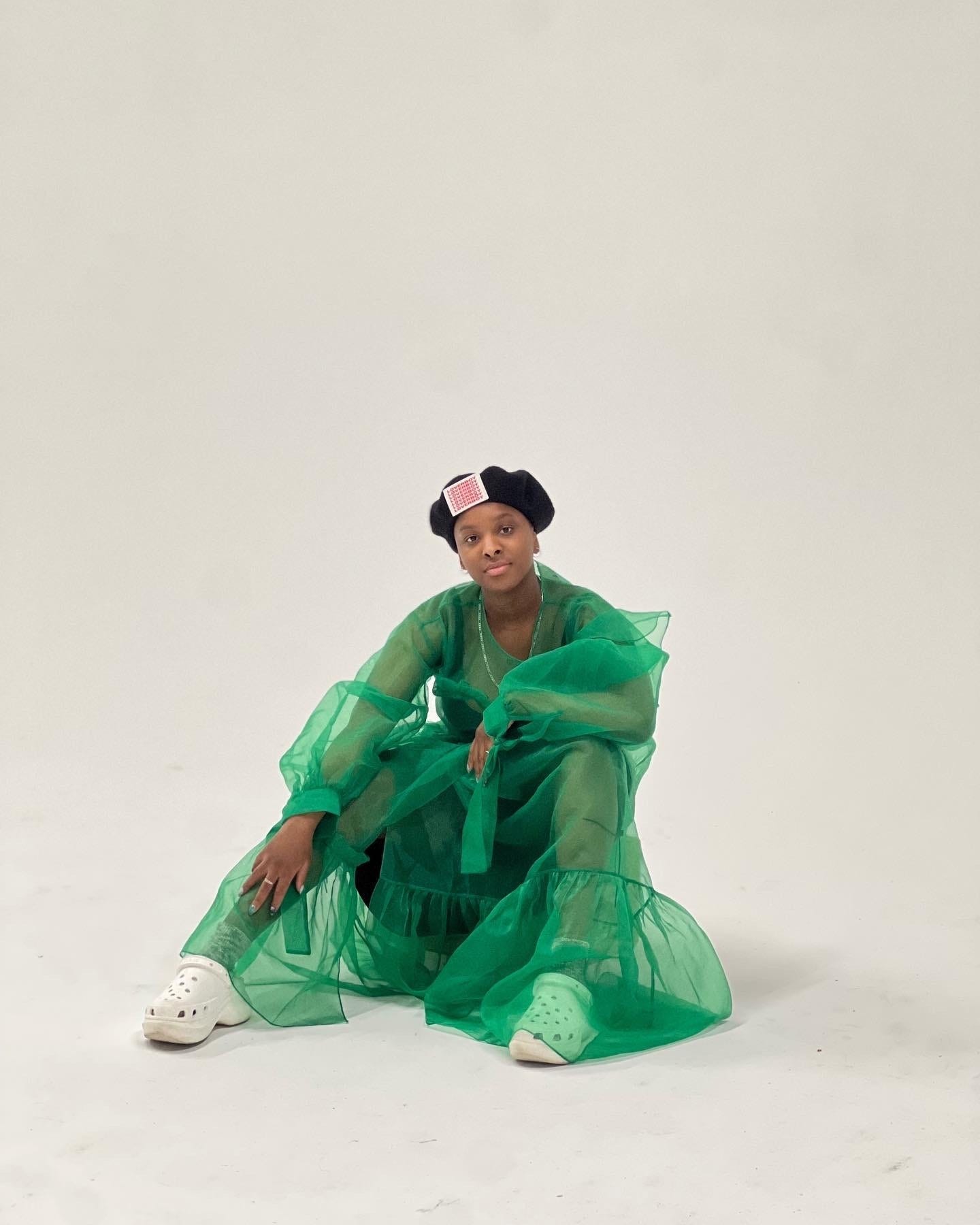
nènè mk is a queer sweet-blooded child of ayiti and mali’s diasporas living in tiohtià:ke/mooniyang/montreal. You can explore more about them and their creative practice on their website, substack, and instagram.
“felt futures” is an embodied, experimental concept that I have named, published about in my book collection “may we dream and design felt futures” (Thick Press, May 2025), and continue to practice alongside fellow dreamers and designers.
The inquiry “who do you honor?” comes from Chapter 3: Who Do You Honor in the book, Making and Being: Embodiment, Collaboration, & Circulation in the Visual Arts by Susan Jahoda and Caroline Woolard.
“Before all of this, there was a deep Black dream that woke as us. And we are the ones in between enough, dream-eyed enough, exhausted enough to remember.” is a passage by Alexis Pauline Gumbs that appears on page 90, within "honor your boundaries," the ninth chapter of the book Undrowned: Black Feminist Lessons from Marine Mammals.
Within the article, The Radicalism of Toni Morrison: How the debut novel by the Nobel Prize-winning author changed the way we think about American literature, Toni Morrison shares the seeds for her first novel were planted: out of “a lot of questions I had, memories I had, a lot of painful experiences I had witnessed or been privy to. All of that sort of collected around an idea, shaping The Bluest Eye.”
The closing statement “This download came after a conversation with Dr. Barbara Holmes who asked me, “What does it mean to listen darkly?” breathes in the essay, learning to listen, pages 15-19, Healing Justice Lineages: Dreaming at the Crossroads of Liberation, Collective Care, and Safety (North Atlantic Books, 2023).
Tracee Stanley describes what it means to embody a practice, “A sense of carrying the wisdom of the practice in your cells—you are in such a deep relationship with the practice that it becomes a part of you,” in Radiant Rest: Yoga Nidra for Deep Relaxation & Awakened Clarity.
This inquiry echoes a similar question posed by nènè myriam konaté within the invitation for me to share my reflections on their offering, The Clap Back Manifest(o).
In the book, Dear Senthuran: A Black Spirit Memoir by Akwaeke Emezi, they share: “spells are the way we make the future we desire more real.”
"begin by feeling" is a direct adaptation of the network principle "we begin by listening" by Allied Media Projects.
I read all this and it’s very good and touching